Design and craft / Case study
This website
A small game set at Eduard’s cabin in Nova Scotia: walk around, meet his dog, and find his résumé and projects in the place.
The problem
My last redesign of this site was generated by a coding agent with almost no input from me. It looked like every other portfolio, and I rejected it.
The thing I care about most in software is that it is designed on purpose. A site about my work should be built that way too. So this time I decided everything: the place, the story, each interaction and each line.
What it does
The site is a small game. You arrive at my cabin in Nova Scotia, where I'm working on the deck. My dog Rusty brings you his plush cow. A small robot called HUGO floats ahead of you through the cabin, the woodshed and the brook, then calls you back to the fire at nightfall.
The work is in the place. My résumé is on the table in the cabin, next to my to-do list. Past projects are in boxes on the workbench. At the fire you pick a question and I answer it. Along the way you can split wood, fish at the brook and tick off a list of things to find.
A bar in the corner goes straight to my work, my résumé and my contact details, for anyone in a hurry. Every project also has its own page.
How it works
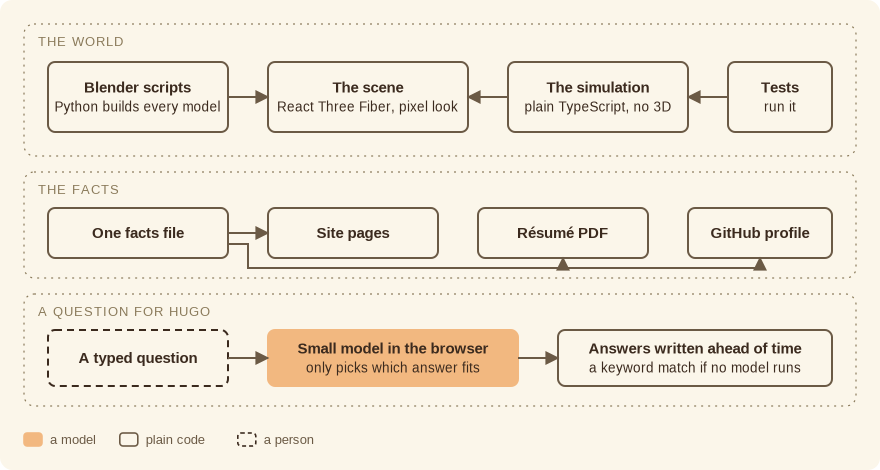
- Drawing. Next.js and React Three Fiber draw the scene. The pixel look comes from rendering at low resolution and scaling up, with flat toon shading and an outline pass.
- The world. Walking, pathfinding, Rusty's fetch and the fishing and wood-splitting games are a simulation in plain TypeScript. It has no 3D code in it, so ordinary tests can run it.
- The models. Python scripts build every model in Blender. A change to the cabin is a change to a script.
- The facts. One file holds the facts the site, the résumé PDF and my GitHub profile are built from. Each headline number says how it was counted, and a test fails if the résumé prints a number that file doesn't define.
The choices
I direct, the agent builds. For every decision the agent offers options and one recommendation, then waits. Each decision is logged with my own words. There are more than a hundred.
Look before describing. Every change is checked in a real browser, on a phone and a desktop, with screenshots, before I'm asked to review it.
Tests for a game. The first version of walking kept getting stuck, so guests now find their way with A* pathfinding on a ten-centimetre grid. Tests check that a guest can reach every spot the game walks them to.
It has to run on a slow device. A Lo-Fi mode halves the resolution and turns off shadows and outlines. It switches on by itself on devices with four or fewer processor cores or 4 GB of memory or less.
Where AI fits
HUGO never writes a sentence. Every answer he gives was written ahead of time, and I approved each one.
When you type your own question, a small model running in your browser picks which prepared answer fits best. That is all it is allowed to do. If your device can't run it, a keyword match does the same job. My answers at the fire are fixed too: you choose the question, not the words.
I tried letting the model answer freely. It spoke as me and invented hobbies I don't have. An AI pretending to be me is the one thing this site won't do.
Where it is now
Live. The cabin, the woodshed, the brook and the fire are all open, and the game has no sound yet. The plain pages for my work, the résumé and my contact details are one click from anywhere in it.